


Delivered by LYVA Labs and funded by BRITE, this new incubator programme supports academic innovators from the BRITE partner institutions to explore the potential of their biologics and related innovations beyond the research environment. By combining practical support, expert guidance and access to targeted follow-on funding, the programme will help participants build the knowledge, confidence and connections needed to advance their innovation beyond the lab and towards real-world impact.
Who is it for?
The Biologics Incubator is designed for academic researchers across the BRITE ecosystem who are beginning to explore the pathway beyond research and towards translation, commercialisation and impact. You may be a good fit if you are:
An academic innovator:
- Post-doctoral or Early Career Researcher (ECR)
- Principal Investigator (PI)
- Research project team
Applications from project teams are particularly encouraged to maximise engagement with the programme and support progression of the underlying innovation.
Developing a biologics-related innovation:
- Biologics (see Figure 1)
- Diagnostics – biomarkers, assays and companion diagnostics
- Enabling technologies – formulation and delivery platforms, manufacturing technologies, analytical tools, AI and other technologies supporting biologics development
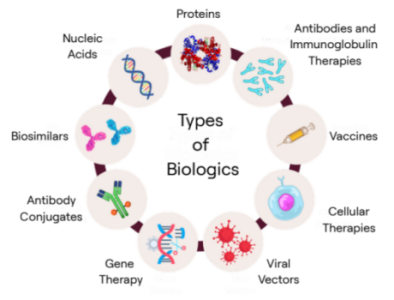
Figure 1. Exemplar biologic modalities considered within the remit of the BRITE programme, additional modalities will be considered.
Working on an early-stage opportunity:
- Defined scientific concept with early supporting evidence
- TRL 2-3 (see Figure 2)
Addressing a meaningful challenge and ready to engage:
- Clear unmet need or defined problem
- Potential for patient, societal or commercial impact
- Willing to fully participate in programme activities and explore commercialisation
No previous commercialisation experience is required. The programme is designed to support researchers who are beginning to explore the future potential of their innovation.
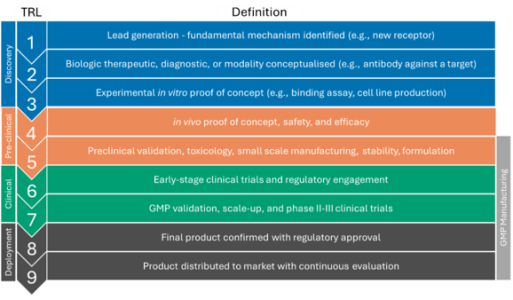
Figure 2. Standardised framework for technology readiness level definitions, adapted from UKRI definitions, and modified to contextualise within the biologics space (UKRI, 2025).
Incubator Content
Our incubator programme offers cohort learning, 1-2-1 mentorship, sector-specific expertise and introduction to biomanufacturing scale-up expertise. Through modular, expert-led workshops, mentoring and access to ecosystem partners, participants will gain a clearer understanding of how to assess and understand commercial opportunity, define your differentiation from competition, explore development pathways, build your network and explore routes to commercialisation.
Participants will follow a programme to create a roadmap to develop their innovations beyond the lab (Figure 3). Each in-person interactive session requires a commitment of approximately half a day.
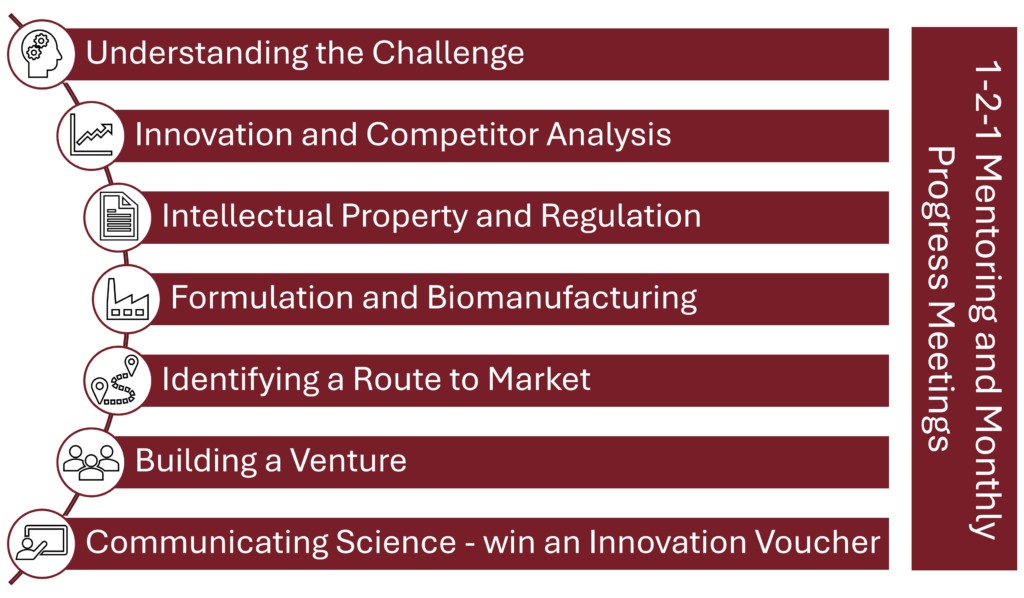
Figure 3. Overview of BRITE-LYVALabs co-designed biologics focused pre-spinout incubator journey.
Innovation Voucher Opportunity
In the final session of the programme, participants will have the opportunity to present a cohesive development plan for their innovation and apply for an Innovation Voucher worth between £5,000 and £10,000 to support the next steps.
The voucher is intended to fund non-laboratory activities that strengthen the commercialisation and translation journey of an asset, such as market assessment, intellectual property advice, regulatory planning, customer discovery, business model development, commercial strategy, specialist consultancy or engagement with potential partners and end users.
We encourage all participants to engage in discussions with their technology transfer officers throughout the programme for additional support to prepare for the innovation voucher presentation. Successful applicants will be expected to use the voucher within the lifetime of the BRITE programme. Funded activities should therefore be completed before the end of the programme in June 2028.
Key Contacts
Edge Hill University: Christopher Hughes (hughesch@edgehill.ac.uk)
Liverpool John Moores University: Peter Leather (P.Leather@ljmu.ac.uk)
Liverpool School of Tropical Medicine: Matthew Kelbrick (Matthew.Kelbrick@lstmed.ac.uk)
University of Liverpool: Alexander Osgerby (Alexander.Osgerby@liverpool.ac.uk)
BRITE Team: BRITE@lstmed.ac.uk
Important Dates
Status: Open
Submission Deadline: Friday 8th January 2027
Application Reviews: 11th January 2027 to 29th January 2027
Application Outcomes: 1st February 2027
Incubator start date: March 2027
FAQs
I’m not sure whether my project is eligible. Should I still apply?
Yes. If you’re unsure whether your innovation falls within the scope of biologics, diagnostics or enabling technologies, please contact your university key contact listed above or the BRITE team to discuss your project before applying.
Can I apply as part of a project team?
Yes. We actively encourage project team participation and welcome applications where multiple team members can engage with the programme.
Does applying guarantee a place on the programme?
No. Applications will be assessed against agreed selection criteria and places will be offered to the highest-ranked projects.
Do I need to have engaged with my TTO previously?
Previous engagement with a TTO or commercialisation support team is not required, but would be expected prior to prepare the application.
Do I need a patent, a spin-out company or to be investor ready?
No. The programme is designed for researchers who are beginning to explore the commercialisation and translation of their innovation. Projects at any stage of IP development are welcome, and participants do not need an existing spin-out, industry partner or investment-ready opportunity.
What do you mean by a biologics innovation?
Examples include therapeutic antibodies, vaccines, recombinant proteins, cell and gene therapies, RNA therapeutics and phage or microbiome therapies. Please refer to the examples provided on this page.
What do you mean by an enabling technology?
Enabling technologies are innovations which support the discovery, development, manufacture or delivery of biologics. Examples include manufacturing technologies, drug delivery platforms, analytical tools, AI-enabled approaches and other translational technologies.
My project is above TRL 3. Am I still eligible?
The programme is targeted at projects around TRL 2-3, but applications from more advanced projects may be considered where participation would provide clear benefit. If you are unsure, please contact your university key contact listed above or the BRITE team to discuss your project before applying.
How much time will the programme require?
Participants should expect to attend scheduled sessions and complete activities between sessions. Further details will be provided in the application pack.
Do all participants receive an Innovation Voucher?
No. Participants will have the opportunity to apply for an Innovation Voucher worth between £5,000 and £10,000 following their final presentation. Applications will be assessed separately, and awards are not automatically made to all participants.
What can the Innovation Voucher be used for?
The Innovation Voucher is intended to support non-laboratory activities that strengthen the commercialisation and translation of an innovation. This may include market assessment, intellectual property advice, regulatory planning, customer discovery, business model development, commercial strategy, specialist consultancy, or engagement with potential partners and end users. The voucher is designed to help projects progress towards further translation, commercialisation and impact.